
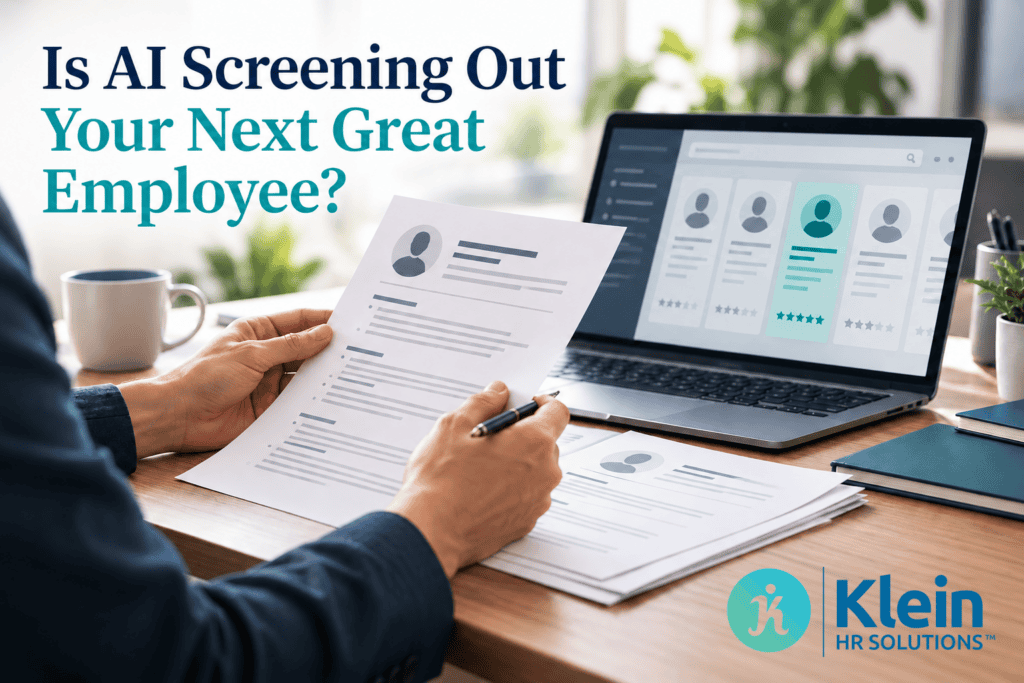
A resume offers a snapshot of a candidate’s experience, but it rarely tells the whole story. Relevant skills, accomplishments, and potential are not always obvious on paper. Sometimes, it takes a conversation to understand how someone’s background connects to the position and what they could bring to the team.
Artificial intelligence can help employers organize applications and reduce the time spent reviewing resumes. However, using it to decide who moves forward requires careful consideration. When candidates are screened out before an HR professional reviews their qualifications, companies may overlook talented people who deserve a closer look.
When qualified candidates never reach your desk
HR Executive’s article, “AI resume screening is creating a ‘visibility gap’ for recruiters,” puts a useful name to this concern. For employers, it raises an important question: Who are we failing to see? hrexecutive.com
Consider a candidate who managed scheduling, budgets, vendors, and staff at a small business. Their title might have been “office coordinator,” even though their responsibilities closely match your operations manager opening. Depending on how a screening tool evaluates experience, that person could receive a lower ranking than someone with the expected title.
The same concern applies to career changes and employment gaps. Someone returning after caring for a parent may bring years of relevant experience. A veteran may have substantial leadership skills described in language unfamiliar to a civilian employer. These resumes deserve thoughtful consideration.
This problem began before generative AI
Automated screening is not new, and not every applicant tracking system uses AI. Some systems apply employer-defined filters; newer tools may analyze language and rank candidates. Understanding that distinction helps employers ask better questions about their hiring process.
In his 2021 Harvard Business School article, “How to Tap the Talent Automated HR Platforms Miss,” Joseph Fuller explains how rigid hiring requirements can exclude capable applicants because of employment gaps, education requirements, or experience that does not precisely match a job description.
If a position has remained open for months, the problem may be partly in how the company defines and screens for qualifications.
A ranking deserves scrutiny
Employers should also question the assumption that a computer-generated recommendation is automatically objective.
A 2024 University of Washington study found racial and gender bias when three AI models ranked resumes with names associated with different demographic groups. Those findings concern the models and conditions studied; they do not establish that every hiring tool behaves identically. They do show why employers should evaluate screening tools carefully.
Human reviewers need clear standards, too. Simply adding a person at the end of the process is insufficient if that person accepts every ranking without examining the underlying qualifications.
How to keep good candidates in consideration
Start with the actual job. Before posting an opening, identify what the employee must accomplish. Separate essential qualifications from preferences. A required license may be necessary. Experience with your exact software may be teachable. Treating both as automatic rejection criteria can unnecessarily narrow your search.
Understand what your tool evaluates. Ask your vendor or recruiting team how resumes are ranked, which requirements trigger rejection, and whether recruiters can review excluded applicants. Ask what testing supports the tool’s use for your hiring needs. You should be able to explain why someone advances or is screened out.
Review a sample of rejected applications. Periodically examine resumes that did not make the shortlist. Look for relevant accomplishments, equivalent experience, and qualifications expressed differently. If suitable applicants keep appearing in that sample, revisit the screening process.
Use consistent conversations and practical assessments. A brief screening call can clarify responsibilities that a resume leaves unclear. Ask candidates the same core questions and, where appropriate, use a job-related exercise. This provides better evidence than relying entirely on resume wording.
Measure the results. Track whether the process produces qualified interviews and successful hires. Fast screening has limited value if the position stays vacant or the selected employee cannot perform the work.
Technology can make recruiting more manageable when employers use it with care. Experienced HR judgment helps connect an applicant’s background to the business’s actual needs. That connection is often where a promising hire becomes visible.
If your company is struggling to sort through resumes and find quality candidates, this is an area where I excel. At Klein HR Solutions, I help businesses clarify hiring needs, evaluate applicants, and recognize relevant experience that may otherwise be overlooked. Whether you need help with one difficult search or ongoing recruiting support, I can bring an experienced HR perspective to your process. Contact me at tammy@kleinhrsolutions.com to discuss your hiring needs.