
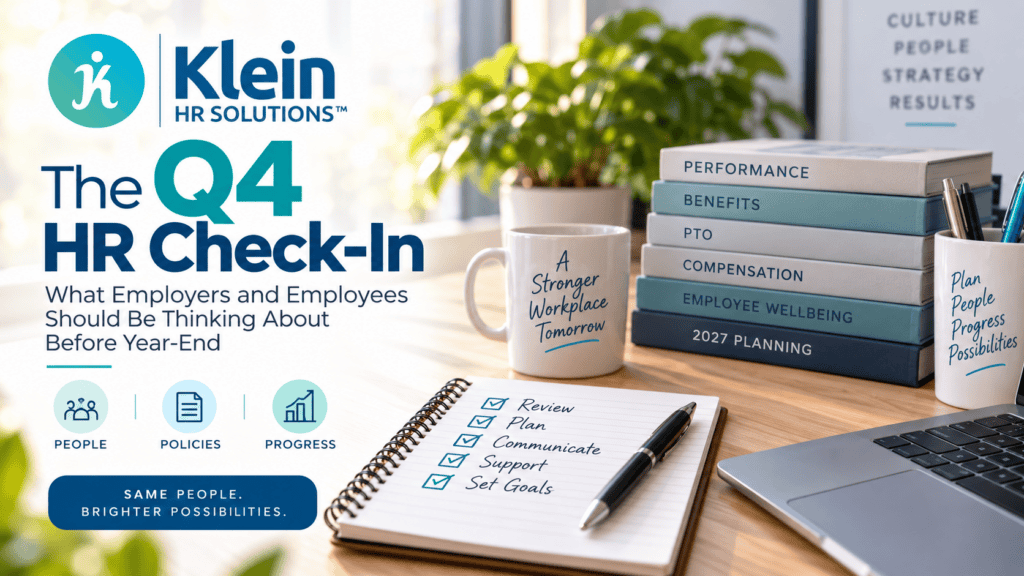
The fourth quarter has a way of arriving faster than anyone expects. One minute, businesses are settling into their summer routines, and the next, conversations have shifted to year-end goals, performance reviews, benefits, holiday schedules, bonuses, and plans for the year ahead.
After many years working in human resources, I’ve learned that Q4 can be one of the most important and potentially stressful times of the year for both employers and employees.
For employers, there’s pressure to finish the year strong while planning for the next one. For employees, there are often questions about performance, compensation, benefits, time off, and what the future holds.
The companies that handle this period best tend to have one thing in common: they communicate early instead of reacting late.
Performance Reviews Shouldn’t Come With Surprises
If your organization conducts annual performance reviews, now is the time to make sure managers are prepared.
Employees should have a reasonably clear understanding of how they are performing before they walk into a formal review. If the first time someone hears about a significant performance problem is during their year-end evaluation, there has likely been a communication breakdown somewhere along the way.
Managers should review goals, document accomplishments and concerns, and provide feedback based on specific examples rather than general impressions. The U.S. Equal Employment Opportunity Commission (EEOC) also recommends that employers communicate performance standards, apply them consistently, and use relevant facts when explaining whether an employee has met expectations.
This is also a good opportunity to make performance conversations more forward-looking. What does the employee want to accomplish in 2027? Are there skills they want to develop? Is there a path for advancement?
A good review shouldn’t simply close out 2026. It should help start 2027 with direction.
Open Enrollment and Benefits Need Clear Communication
Benefits are another major Q4 concern. Employees may be reviewing health plans, retirement contributions, flexible spending accounts, and other benefit elections.
This is an area where HR communication really matters.
The Society for Human Resource Management (SHRM) has emphasized moving away from reactive open-enrollment management toward proactive planning and better employee communication throughout the process. Employers should give employees enough time and information to understand their options rather than overwhelming them with documents and deadlines at the last minute.
Employees should also take this opportunity to actually review their elections rather than automatically choosing what they selected last year. Life circumstances change, and benefit needs can change with them.
Retirement benefits deserve a look, too. The IRS announced that the employee contribution limit for 401(k) plans increased to $24,500 for 2026, making Q4 a good time for eligible employees to review their contributions and overall retirement strategy.
PTO and Holiday Scheduling Can Become Complicated Quickly
Unused PTO, holiday requests, and year-end staffing needs can create frustration if policies aren’t clear.
Employers should review their PTO policies now. Does unused time roll over? Is there a maximum carryover? Are there blackout dates or staffing requirements during the holidays? Are managers applying the rules consistently?
Employees, meanwhile, shouldn’t assume they can wait until December to use a large amount of remaining PTO.
Clear communication now can prevent a lot of unnecessary conflict later.
Bonuses and Compensation Need Extra Attention
Year-end bonuses are always a popular topic—and sometimes a confusing one.
Employers should be careful about how bonus programs are structured and communicated. Under the Fair Labor Standards Act, whether a bonus is considered discretionary or nondiscretionary can affect how it is treated when calculating overtime for nonexempt employees.
According to the U.S. Department of Labor’s guidance on bonuses under the Fair Labor Standards Act (FLSA), bonuses based on predetermined criteria such as production, quality, attendance, or other established measures may be considered nondiscretionary and may need to be included in an employee’s regular rate of pay when calculating overtime.
In other words, simply calling something a “discretionary bonus” doesn’t necessarily make it one.
Compensation decisions should be reviewed carefully and communicated thoughtfully.
Don’t Ignore Q4 Burnout
The end of the year can also bring a difficult combination of deadlines, holiday obligations, vacations, reduced staffing, and pressure to hit annual goals.
Managers should pay attention to workload and morale.
Sometimes small changes make a meaningful difference: prioritizing what truly needs to be completed before December 31, encouraging employees to use available time off, recognizing strong work, and avoiding unnecessary last-minute projects.
Employees should also feel comfortable discussing unrealistic workloads before they become unmanageable.
Use Q4 to Prepare for 2027
Finally, employers should use the last quarter of 2026 to look beyond immediate year-end tasks.
Review your employee handbook. Look at staffing needs. Evaluate compensation and benefits. Identify recurring employee-relations issues. Review job descriptions and classifications. Consider training needs and succession planning. Most importantly, ask whether your current HR practices still fit the business you’ve become.
You don’t have to solve everything before January 1. But you should know what needs attention.
After decades in the human resources space, Tammy has seen how quickly small HR issues can become larger problems when they aren’t addressed early. At Klein HR Solutions, Tammy works with businesses to create customized HR plans based on what they actually need – whether that’s ongoing HR support or assistance on an as-needed basis. From employee relations and performance management to policies, compliance, benefits communication, and workforce planning, Klein HR Solutions can help your organization finish 2026 with greater confidence and enter 2027 with a practical HR strategy designed specifically for your business.